
My first memory of the Cuban revolution goes back to 1961 when several Cuban boys showed up at my high school in Albuquerque. They were part of Operation Peter Pan. At the time, I had never heard of this operation. I was a teenage girl in a Catholic High School. I was just trying to avoid the nuns seeing my short rolled-up uniform skirt. If they suspected it was too short, they gave us the test: kneel on the floor. The bottom the skirt had to touch the floor. Cuba? I had heard of the Cuban revolution but that was pretty much the extent of it. Much later in life I found out that those boys who showed up in some of my classes were part of the desperate attempt by Cuban parents to get their children out of Cuba.
Cuba goes Communist
After the American invasion of the Bay of Pigs failed, Fidel declared himself to be a Marxist Leninist. Many Cubans had previously thought about leaving but were waiting to see which way things were headed. Once Castro made his proclamation they decided to get their children out of Cuba for fear of losing their parental rights They did not want the Cuban government to indoctrinate their offspring into Communism. Nor to ship them off to another Communist country.
The Catholic Church and the American government financed the project of the airlift. Over 14,00 unaccompanied children came to the U.S. under this program. Most were teenage boys. Some were lucky enough to go to a loving foster homes but many did not fare so well. Carlos Eire describes the Cuban Revolution, the Peter Pan airlift and its aftermath in his heartbreaking memoir Waiting for Snow in Havana.
I arrived in Havana on a sanctioned tour 61 years later. I was a retired Spanish teacher. It was high on my bucket list. The country had been closed to Americans depending on who was the US President. There has been an embargo of Cuba since 1958 which was finally codified in 1996 by the Helms-Burtan Act. I have always seen the embargo as an exercise in futility. It has lasted 65 years and has not changed anything. It punishes the wrong people and allows those in power to get the luxury goods they want. During the Obama years Americans could go to Cuba on a special tour for which just about anyone could qualify. I jumped at the chance.
Camagüey, Cuba
I have traveled three times to Cuba. The last time was my favorite. We visited Camagüey, which is in the middle of the alligator-shaped island. It’s my favorite visit. It’s not a large city and there were not a lot of tourists there as in Havana. Tourists from all over the world go to Cuba for the tropical weather and the great beaches. Havana is a fun place to go especially seeing the old cars from the 50s. It’s like going back in time. The beaches on the north side of the island are beautiful and loaded with Canadians. However, the American government still does not permit citizens to go to this part of the island.
My first morning in Camagüey I decided to wander around by myself which I believe may be for me the best way to get unique photos. This is especially true when I can speak the language well. Even knowing a few phrases can break down barriers. And the biggest barrier breaker is a sincere smile. It’s the international language.
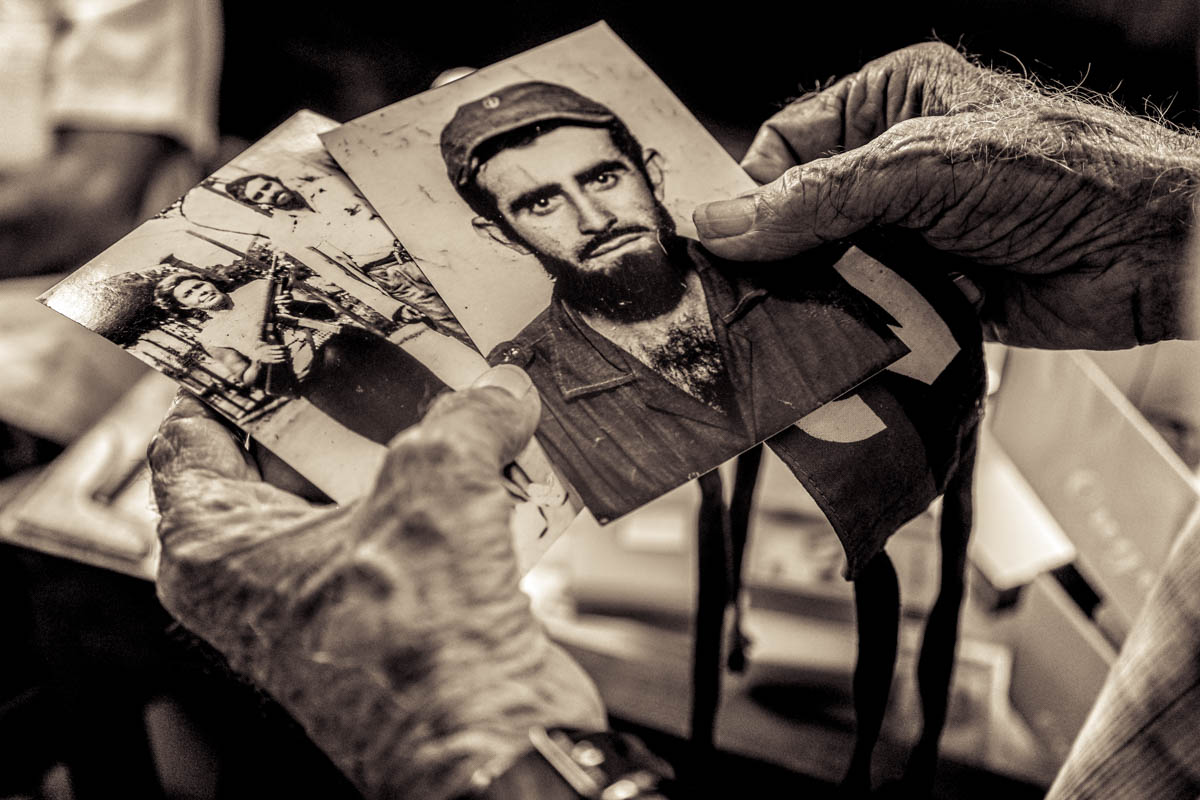
My very first stop was at a small shop that appeared to be a stamp store. Because of the US embargo there are very few goods available. So it was not surprising to walk into this shop and see little for sale. There were two gentlemen who seemed to be good friends who were just sitting there chatting. When the man I assumed to be the owner of the shop heard me speaking Spanish, a wonderful conversation ensued. He was a former soldier in the Castro revolutionary army. He was eager to show me his old photos and memorabilia from sixty years ago.
Cuban Generosity
Because of the U.S. embargo the Cubans have very little in material goods. Poverty is pervasive. But certainly not poverty of spirit and generosity. I was impressed with how quickly they share what little they have. I was offered a flower from a street vendor who allowed me to take his photo. He had very few blooms but was willing to share one with one.
While walking down the street of a small town I stopped to talk to a gentleman who was fixing his motorcycle. He was a retired university economics professor. And since everyone theoretically lives on the same salary no matter what your profession is, he had very little. We chatted. I met his wife. Before I walked away they insisted on giving me a bag of mangos.
If they have nothing physical to share, they share their friendship and stories. As did the man in the above photo with his stories of the revolution and his time in the mountains with Fidel. There were others in his shop/home. I’m not too sure what the relationship was but there was a couple present close to his age watching Television. The husband also wanted to show me photos on his phone of his devotion to the revolution…or at least its history in it. Many have become disenchanted.
If you have never visited this beautiful island, I highly recommend it. Cuba will probably never get back to the glory days of the 40s and 50s when Americans flocked there to vacation or to gamble. Americans can still go depending on which party is in office in the US. There are a few hoops to jump through but it is certainly worth it. I have found that Cuban citizens love Americans. And why wouldn’t they? Everyone I met there seemed to have a relative living here in the States. Including Peter Pan refugees.


Leave a Reply