
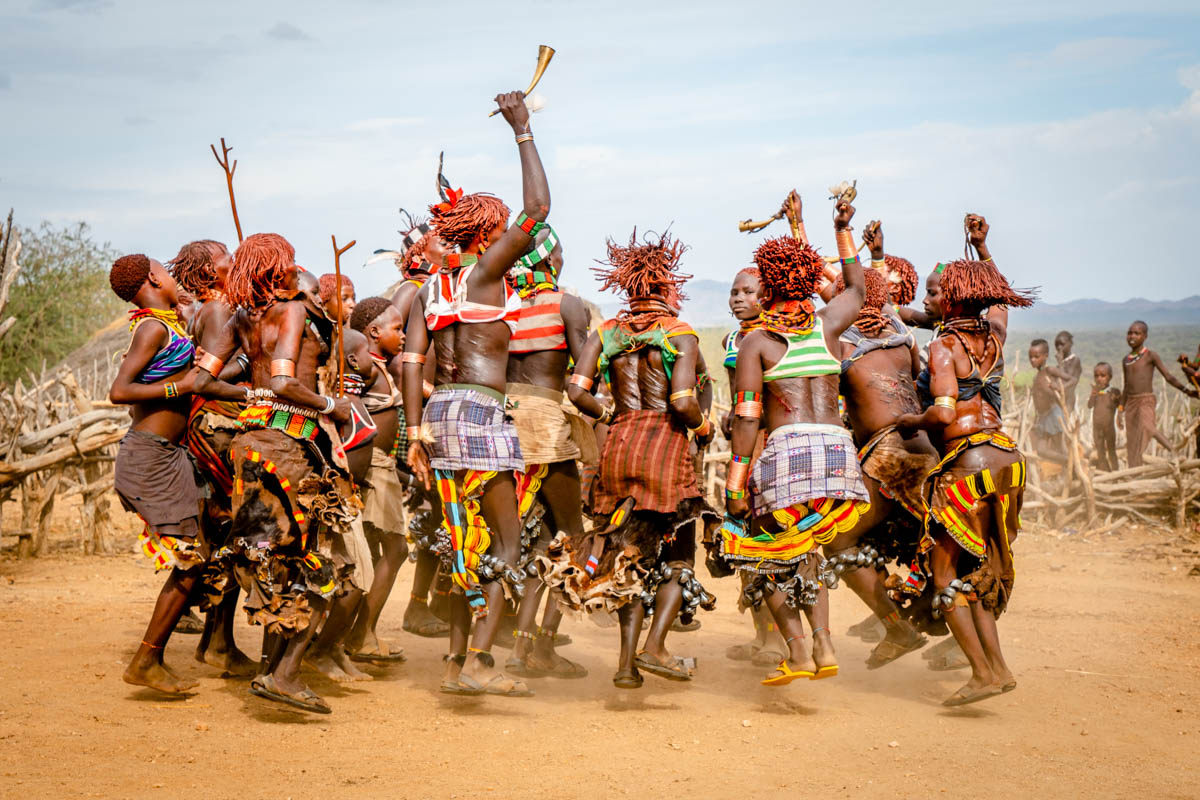
My family moved to Iowa the summer before my senior year in high school. I came out of that experience relatively undamaged psychologically, although some might argue with that. I had heard from my new teen friends in Iowa of cow tipping (NOT really a thing) but cow jumping never came up. The stories of cow tipping was pretty much my complete experience with bovines. And then I went to Ethiopia. I have had some interesting experiences in my world travels but witnessing the cow jumping in the Omo Valley in southern Ethiopia has to rank near the top.
I love photographing interesting faces. A friend I met in a photo workshop in San Miguel de Allende, Mexico suggested I do a tour to Ethiopia, specifically the Omo Valley as it was a great place to photography unusual, interesting people. I had no idea how interesting it was going to get. We landed in Addis Ababa where we stayed in a lovely hotel for a few days. As we headed south, with the exception of our lovely lodging in Arba Minch, the luxury stopped. Because of the lack of infrastructure it was the most uncomfortable trip I have ever done. My grown children always say I’m a wuss. This trip proved otherwise.
Deciding on the subjects of our photos
Generally speaking, when we were going to visit a new tribe to photograph, the local guide and the lead tour photographer would approach the elder to decide which members of the tribe would be photographed and what fee would be charged. Those tribe members who were eager to be photographed wore all their finest accoutrements and had their bodies painted in markings of that particular tribe. The children were incredibly happy and curious. The men were stoic; sometimes looking warrior-like. Many had numerous scars cut into their torso as a mark of each kill of other tribesmen who try to steal their livestock, their only wealth. They brandished AK47s which are a common weapon against the rampant cattle raiding. Young women and their babies were always a treat to photograph. I figured these people were untouched by civilization until I met the chief with a fancy watch and cellphone and had been educated at a major university in the States. He clearly knew the financial gain for the tribe by welcoming tourists who want to photograph.
A local guide is key to a good photo tour
On our final stop our local guide picked up the news that there was going to be a cow jumping close by. Understand that there are no addresses here, no street names, etc. Finding the location of the event was not without some difficulty even though our guide knew the language. We were all thrilled to find out we might be witnessing such a rare cultural event. Our Ethiopian guide was from Addis Ababa and was going to be seeing it for the first time as well.
We arrived rather early in the celebration. The subject of the celebration was still a few hours away from his feat. And he was nervous. This was not a kid. I found out later that most of the tribesmen who attempt this are teens. From the looks of him he looked a bit long in the tooth. Maybe he had tried this before and failed. Our guide informed us that the family has to host and provide food and drink for all the attendees so it could be that they didn’t have the means to repeat the event after he failed the first time.
Ritual whipping before cow jumping
I have to admit that his one took me a bit to get my head around. I needed to put aside my own cultural, first world perspective and just witness what I was seeing without judgment. To understand it all, one has to know that scarring is a status symbol in the Hamer tribe for both the men and the women. Men do it to themselves. The women are another matter.
The young unmarried female relatives show their loyalty to the jumper by presenting themselves for whipping by the Maza, young men who have already achieved manhood by passing the cow jumping test. These young men can then marry, purchase livestock and own land. They paint their faces in an area away from the where the food and drink is being served. When the girls present themselves for whipping with switches, they do so defiantly and without a whimper. They wear bells on their legs and pull their shirts up exposing the midriff for the whipping and subsequent scarring.


The cow jumping
After the whipping ceremony the candidate for manhood enters the enclosure accompanied by other men who are either family and friends. They rub him with sand and smear him with cow dung to deliver him strength. I sensed this was getting to be very tense for the jumper. He seemed much older than the Maza men we had seen preparing for the scarring of the young women.
Several members of the tribe were rounding up cows for the cow jumping. At the time I was confused and repelled (as if the whipping wasn’t enough, right?) by the subject putting his hand into the rectums of several cows. Apparently jumping ten cows in a row four times isn’t difficult enough; they have to be slippery. Hence, the digging for cow dung which they spread on the cattle. The men of the village spend a bit of time capturing and getting ten cows in a line in order for it to be straight enough to jump. The head and the tail are grabbed so they don’t move. The young man takes a running jump and starts his four passes. It was like log rolling but with cows. They also partially shaved his head and he was stark naked. And I mean stark.


I was a lot more excited about the outcome of the cow jumping for this young man than I thought I would be. It was so exciting when he jumped off the last cow after his fourth pass. The entire happy group then went back to the open air enclosure where the family had been hosting. They were to continue the celebration for several days with food, sorghum beer and dancing. Who knows? He may have met his future bride at the dance!
And the entire time I was there, I didn’t see any cow tipping.


Leave a Reply